
- New Genres
- Textiles
- Premiere Pro
Share
This project was created to the prompt of "The Reconstructed Artifact." The artifact that I chose for my final project was the Qipao, a Chinese dress that is commonly associated with modern-day Chinese clothing. I chose qipao because when I was formulating my ideas for this project, I truly could not see myself working on anything that was not made of fabric. My first thought was to deconstruct it literally and transform it into wooden pattern pieces, pieces that could be used to replicate the piece forever and forever through tracing them onto fabric. However, I found that this analysis did not lead me to unveil any specific biases about the qipao and what its historical and modern-day impact is. In this line of thinking, I began researching the history of the qipao, and how it evolved from the long, flowy traditional Chinese clothes called hanfu. As a hanfu enthusiast, I see the stark contrast between qipaos and hanfu, and it’s sometimes jarring. My research told me that qipaos are actually not derived directly from hanfu, of the Han people, but instead from Manchurian clothing. The Manchurians took over Han China in the 1800, leading to a shift in the dominant culture and clothing of China, transforming what I thought to be traditional Han clothing into something that was more Manchurian. The modern-day qipao, then, is another interpretation of Manchurian clothing in a modern, Westernized fashion. The qipao has been used to sexualize Chinese women, and is often used as inspiration for Asian fetishization. This sparked my interest in the development of a traditional yet modern Chinese dress.
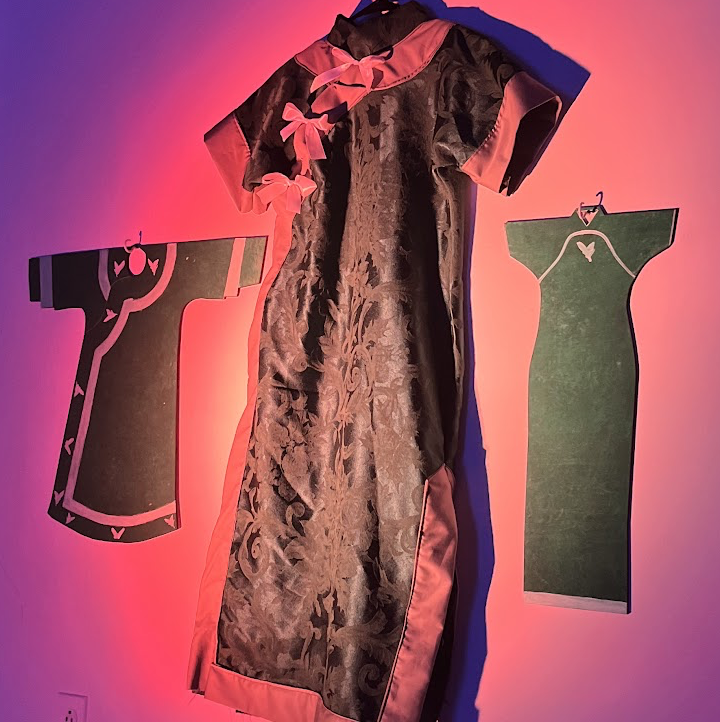
To redesign and reconstruct what Chinese dress looks like to me, I began with the idea of comparing two wooden cutouts of the pattern pieces of a traditional Ming dynasty gown and a traditional 1900’s qipao. In my research, I also found that the traditional way to cut these was to cut it in one continuous piece, so there is only one seam in the entire garment. This was interesting to me as it meant I had to alter my project idea - the entirety of the pattern pieces would not have fit onto the small wooden pieces I had set aside for this project. I laid out the wooden pieces, one for the Ming dress and one for the qipao. I decided to paint them green, a color traditionally used femininely. During the Song and Ming dynasties, brides would wear green as opposed to the traditional festive red to symbolize their graduation into womanhood. However, it’s an interpretation that has been mostly lost in time, and brides nowadays mostly stick to red. I found throughout this project that as I was learning about how traditional Chinese clothing developed, I was also learning about how the clothing itself was both a representation of status and identity. Color, material, and coordination were all factors in how Chinese women, without words, could express themselves and their opinions in a society that constrained them.
For the final installation and presentation of this project, I created my version of what an ideal Chinese dress looks like to me: I combined elements from the Ming gown and the qipao that I felt best represented my identity. I kept the qipao’s collar, the Ming gown’s bias edges, and the traditionally feminine green. Reflecting on the process of the project, I find myself wondering how my own ancestors or even family would view my interpretation of our cultural dress. The translations of clothing and design have been lost throughout the years, yet elements of how it’s interpreted remain. And it’s up to me, a modern-day Chinese woman, to take that and understand and appreciate it. Moving forward, I hold a lot more consideration for what it means to be a woman wearing clothing, and that what I wear is what I am.